
What Are the Chances
Love comes back named

Most of what I publish here demands something of you. Political writing. Poetry. Work that, for the most part, answers to power and urgency.
This is the opposite. Starting now, every Friday, a story, a musing, or a reflection.
(It’s 6:00 in the morning as I write this, which technically makes it Saturday morning, but I live on writer’s time.)
This first one is about my grandfather Al, the dogs we love and lose, and what happens when you ask the dead for something. And they answer.
My grandparents lived on the southwest side of Chicago, in one of those brick bungalows built so close together you could stand between two of them and touch both houses at once. As a child, I would walk through their door, and my grandfather’s Old Spice reached me before he did. Then coffee. Then, cigarette smoke settled deep into the walls. My shoulders came down. They always came down. Whatever I had carried to get there was dropped at that door. I was known there — the way you are when people laugh at your stupid knock-knock jokes and mean it.
Gold sofa, the cushions covered in thick plastic — that classic move, the good furniture guarded from the people who used it. Gold drapes. Brown furniture in warm seventies hues. A China cabinet of teacups and good china arranged just so. Plates on the walls. Classical music. Everything impeccably clean.
The quiet there had a sound. Not silence. Order.
My grandfather was always impeccably dressed — navy slacks, a collared shirt with a breast pocket, a pocket protector lined with pens, and a belt. Tall, slender, and fit the way working men get fit — not from a gym, but from farm stock and decades of work. Gray hair combed and parted, not a strand out of place. Crystal blue eyes. Large, strong hands. His only vice was cigarettes.
My grandmother was serious and full of energy — small and delicate to look at, and unbreakable. She wore her hair short and stylish. The years showed on her, and the cigarettes, but underneath them, you could still find the knockout she had been, the classic Scandinavian features ever-present. She kept the house the way she kept everything, with the precision of a woman who came up on a farm and never forgot that nothing comes free. Tough, fair, unable to waste a thing.
They were middle class — the kind that barely exists anymore. No vacations; they worked hard, and their house was their castle. They both worked and shared the cooking and the housework; my grandmother was proud to be a woman with a career when that was rare. He made her coffee every morning. There was a calm over all of it — the house had a kind of zen, and so did my grandfather.
They sat at that kitchen table — a 1950s diner table with a metal rim — and talked things through over cups and saucers that made even ordinary afternoons feel intentional. I performed my stupid dances. Told my knock-knock jokes. Took up space without calculating the cost. They laughed every time. They never cut me short.
I could just be a kid.
There was a black Labrador retriever. My mother had him first — she accumulated animals the way she accumulated everything, with intensity and then release. She dropped him off at my grandparents’ house and left. His name was Jeff.
My grandfather, whose hearing had begun to fail, heard something else. He heard Jet. A black dog — the name made a kind of sense. Nobody corrected him.
Jet he became.
My grandfather loved that dog the way he loved everything he decided to take care of — completely, with ritual and patience. He fed Jet with a ceremony I have never forgotten. A special, large spoon. Dry kibble in the metal bowl. Then water, poured carefully over and left to seep in — because it had to seep, you waited — and then the stirring. Slow circles with that spoon, working it into a gravy, because that was the proper way to feed a dog. Stir, stir, stir, he’d say softly as he worked. It was a serious honor to be allowed to do it. He’d stand beside me and say it — stir, stir, stir — as if the act required witness. As if love required that kind of attention.
He walked Jet every day. He carried a walking stick at least five feet tall, the handle wrapped in electrical tape — not for himself, but to protect Jet from the dogs that ran loose on the southwest side. His first job on any walk was the dog’s safety. To accompany him was a privilege. I held his sturdy, rugged hand, and he walked that neighborhood with the long, settled familiarity of a man who had earned his place in it.
Every afternoon, weather permitting, he stopped for coffee with his Army buddies from the Korean War — men who had seen things, who sat together the way men do when they’ve been through something unrepeatable. They listened patiently to whatever story I had to tell, however long it took.
I asked my grandfather endless questions about the war — a pest, incessant, the kind only a child asks without embarrassment. He answered everyone with the same patience and earnestness he gave everything. I asked him once what you did if you had to poop while you were shooting at each other. He laughed. You dig a hole, he said. You go, and then you go back to fighting. He had been raised Catholic, though he was never overtly religious. He told me once: There is no such thing as an atheist in a foxhole. I didn’t know what it meant. I never forgot it.
I learned what safe felt like in that house. Everywhere else, I learned to watch for its absence.
Home was a specific kind of noise — screaming, shouting, furniture breaking. Not arriving and leaving but living in the walls, the atmosphere of every room. I learned to read a room before entering it. To register tone before meaning. One of my first memories: my father’s hands around my mother’s throat, my mother struggling to say, Bob, you’re killing me. My sister was a baby. I climbed into her playpen and held her while she screamed. After that, there is no clean sequence — just noise, and the ongoing work of staying ready.
My mother’s parents saw my father clearly. He avoided my grandfather — the one man who could humble him, and my father knew it. With my grandfather, I watched my father go quiet in a way I saw nowhere else, the only place his power left him. He rarely came with us on our visits — a few times, maybe, out of hundreds. My grandparents didn’t hide what they felt about my mother either. As a child, I read it as taking sides. I understand it now. She was a damaged woman who caused damage. He was abusive. They saw clearly what I didn’t yet have words for.
I was about eleven when my grandmother died. After that, the safe place closed. My mother saw to it that we rarely saw my grandfather or Jet again, and it breaks my heart to this day. He deserved more than that. I know I asked for him. I missed him, terribly. I think now that I should have thrown a fit, should have fought to keep going back — but my parents’ marriage was as volatile as ever, my father as obnoxious and self-regarding as ever, and I was a child holding what a child can hold. Maybe I did my best. His house had been the one place none of it reached. When it closed, it closed for good.
She had a pattern, my mother. The same one she had with Jeff.
Snowy is one of my very first memories. I see him in flashes — a golden retriever leaping into piles of fall leaves, the way he’d bat my long curly hair with his paw and knock me right over. I didn’t care. I adored that dog completely. Then one day, my mother gave him away. I was three years old. I sat in his chair for three days and cried the same question: Where is my Snowy? Where is my Snowy? It became a family joke. I was three years old, and I already understood that anything you love can be taken.
I became someone who doesn’t let go.
Simba was my first adult dog — my own, on my own. Also known as the best dog in the whole world in all the history of dogs. A cocker spaniel with a personality far too big for his body — the kind of dog who, if he’d been a man, would have walked around with a cigar hanging out of his mouth, cursing like a sailor. Gorgeous. Street smart. He went to work with me every day, never on a leash, always a whistle away. And when his body began to fail, I waited too long to let him go. I mistook his refusal to quit for proof that he wasn’t suffering, because I needed it to be proof. I kept him here past the point of mercy. By the time I finally gave him a gentle ending, I had already let him hurt for my sake — because I could not stand the room without him. I swore I would never do it again.
Then came Jake. (Simba will get an essay of his own someday. So will Jake. For now, they live here, in this one.)
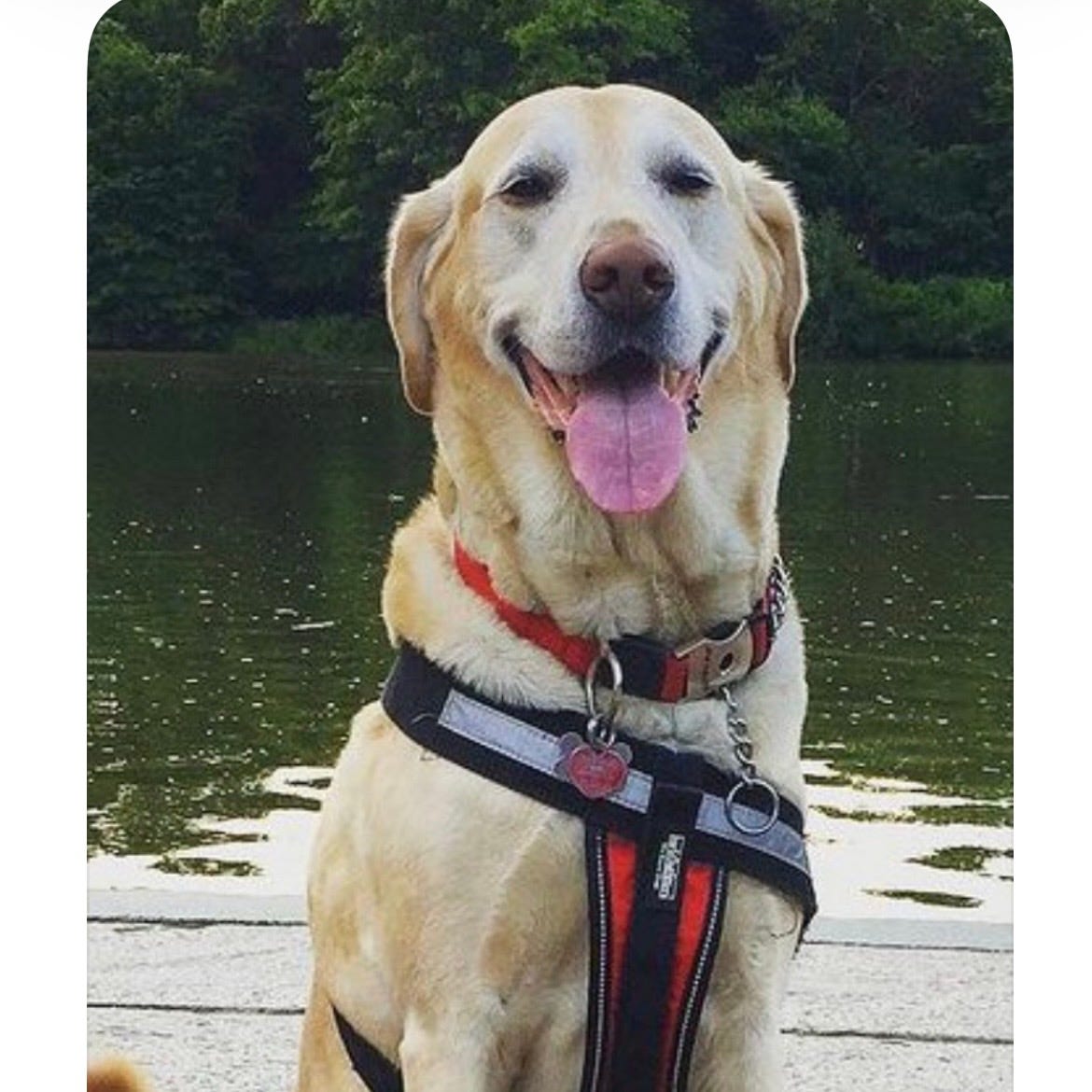
Jake was a yellow Labrador, also known as the second-best dog in the whole world in all the history of dogs. Intelligent, goofy, and the light of my life, he never put a foot wrong in his entire life. Not once. He could charm anyone — humans, aggressive dogs, strangers in airports. At dog parks, he could talk a hostile dog out of its intentions just by existing near it. He was my diabetic service dog, and he took the job seriously — better than I had any right to expect. He went back to school with me when I returned to study as an adult. One afternoon, in an economics class, the professor stopped mid-equation at the board, marker in hand, and said: I swear to you, that dog is paying attention. He was. Jake loved school.
He loved airports and planes and trains and the whole adventure of being in motion through the world. Grants and school programs opened up places I never thought I’d see — even a stretch at Moscow State University; one summer in France. (Those travels are an essay of their own, in time.) Jake came along for all of it — every move, every version of my life I tried on. He was the constant. My best friend, my ride or die.
At eleven years old, his health declined. Not suddenly — a slow, bewildering erosion. His mobility going faster than any of us expected. An unexpected Lyme disease diagnosis, then treatments. A cocktail of pain medication to keep him comfortable. Good days and bad days, good weeks and bad weeks, the not-knowing its own kind of agony. Every good day, I thought maybe. Every bad day I thought is this it.
I had promised myself, after Simba, that I would not do it again — that I would not let my own grief keep a suffering dog alive. Jake was a dog with dignity. He had led an honorable life, full of love, and when his time came, he deserved to be honored with a peaceful ending. Keeping that promise was the hardest thing I have ever done.
For a while, I cried constantly — until I understood he could feel it. I was grieving him to his face while he was still here, still in the room, still needing me. I needed somewhere to put the worst of it, where he couldn’t reach it.
So I made a decision. During the day, I would be present — conscious, grateful, there. At night, in the shower, I let myself come apart. Quietly. The water running, so he wouldn’t hear.
It was in the shower that I talked to my grandfather.
My grandfather Al, had been dead for years. I don’t know exactly when the conversation started — every night, water running, my voice barely above nothing. It wasn’t exactly a prayer. I questioned myself as I said it. If there’s really a heaven. If there are really pearly gates. If any of it is real at all, please be there for him. Let him know how loved he is. Let him know how sorry I am. Be there to greet him. And most of all: do not let him be afraid.
I said it for months. Different words, same ask. Just be there. Most of all, do not let him be afraid.
Late January. I called the vet. I made the decision — nobody made it for me. He went to sleep on his bed, in his room, in the place he knew, without the panic and fluorescence of a clinic. I had promised him that much. I kept it.
After they carried him out of my apartment, I thought my heart would explode. It ached — an actual, physical pain. I made sounds I did not know my body could make. Not crying. Something older than crying. A moan from a place in me I hadn’t known existed. For days. For weeks.
Then came the grief of muscle memory. Holding the elevator door open a beat longer than necessary, still making room. The involuntary thought that it must be time to take Jake for a walk. Rolling over in the morning in that split second before remembering — that brief mercy of forgetting — and then the returning. His food still there. His leash. His bed — large enough that I used to climb into it and sleep there, in the weeks after. I needed to be somewhere that still held the shape of him.
For the first time since my mid-twenties, I was without a dog. A move was coming, too — nothing dramatic, just a move — except it would be the first one I had ever done without a dog. I kept relearning the absence at the door: that small, specific emptiness of turning the key and having no one come to meet you. No nails on the floor. Nobody rounding the corner. No witness.
I was nowhere near ready for another dog. I knew that absolutely.
By June, I was still crying every day. But in June, for the first time, I let myself look at Petfinder. Just looking. I saw a puppy in Texas. Some voice in my head, very clearly, said: That is your dog. I told myself I was losing my mind. He was in Texas. I closed the tab.
In July, the same puppy appeared in a Facebook group for rescue Labs. I left an offhand comment — adorable, too bad he’s so far away. They wrote back immediately. They were bringing a group of dogs cross-country and needed fosters in New York. Desperate — too many dogs, not enough places. I tried every reason to say no.
I said yes.
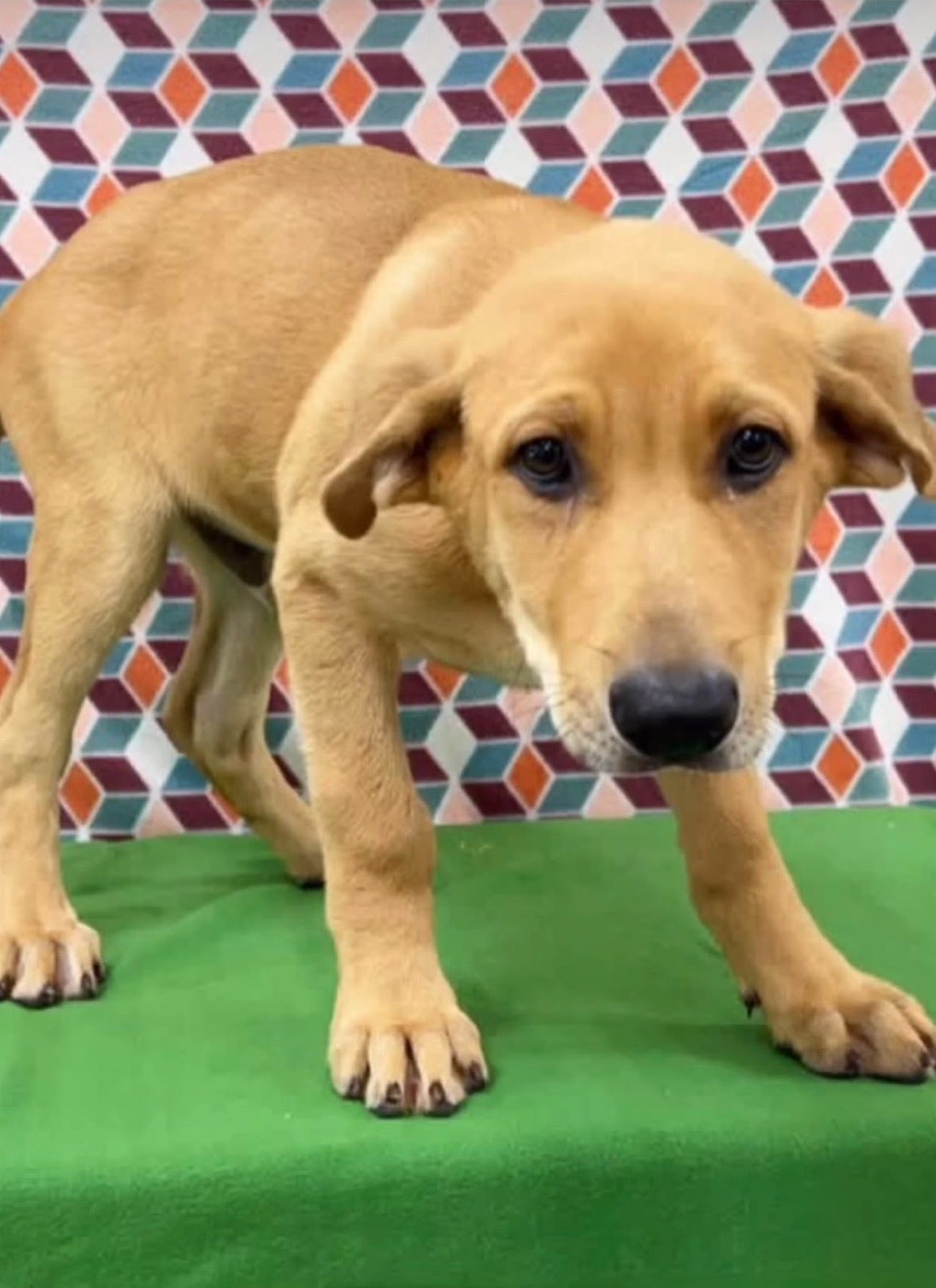
The puppy’s mother had been gone from the start. Someone found the litter on the street; several didn’t survive. The rest, including him, ended up in a kill shelter, due to be put down that very day — until someone got them out. It was there, in the shelter, that he was first given a name. From there: a kind foster family in Texas, then a van heading north on a fly-by-night rescue running on good intentions and not much else. The van broke down again and again. Tennessee. Delays. Weeks of it.
Somewhere in the middle of all that, while he was still in transit, they sent me a video: two puppies, brothers, tumbling over each other — and the one in the blue collar, the one coming to me, working out how to unlatch a gate with his paw. Four months old, already an escape artist.
He arrived in the middle of the night. It was my birthday — August 3rd.
He was four months old and already forty-five pounds — too big to scoop up, and terrified. It was the first time he had ever been separated from his brother. The two of them had been a gang.
And then they told me his name — the one given to him back at the shelter, the name that came north with him in that van. The name no one chose for my sake, the name I never picked and never would have dared to pick.
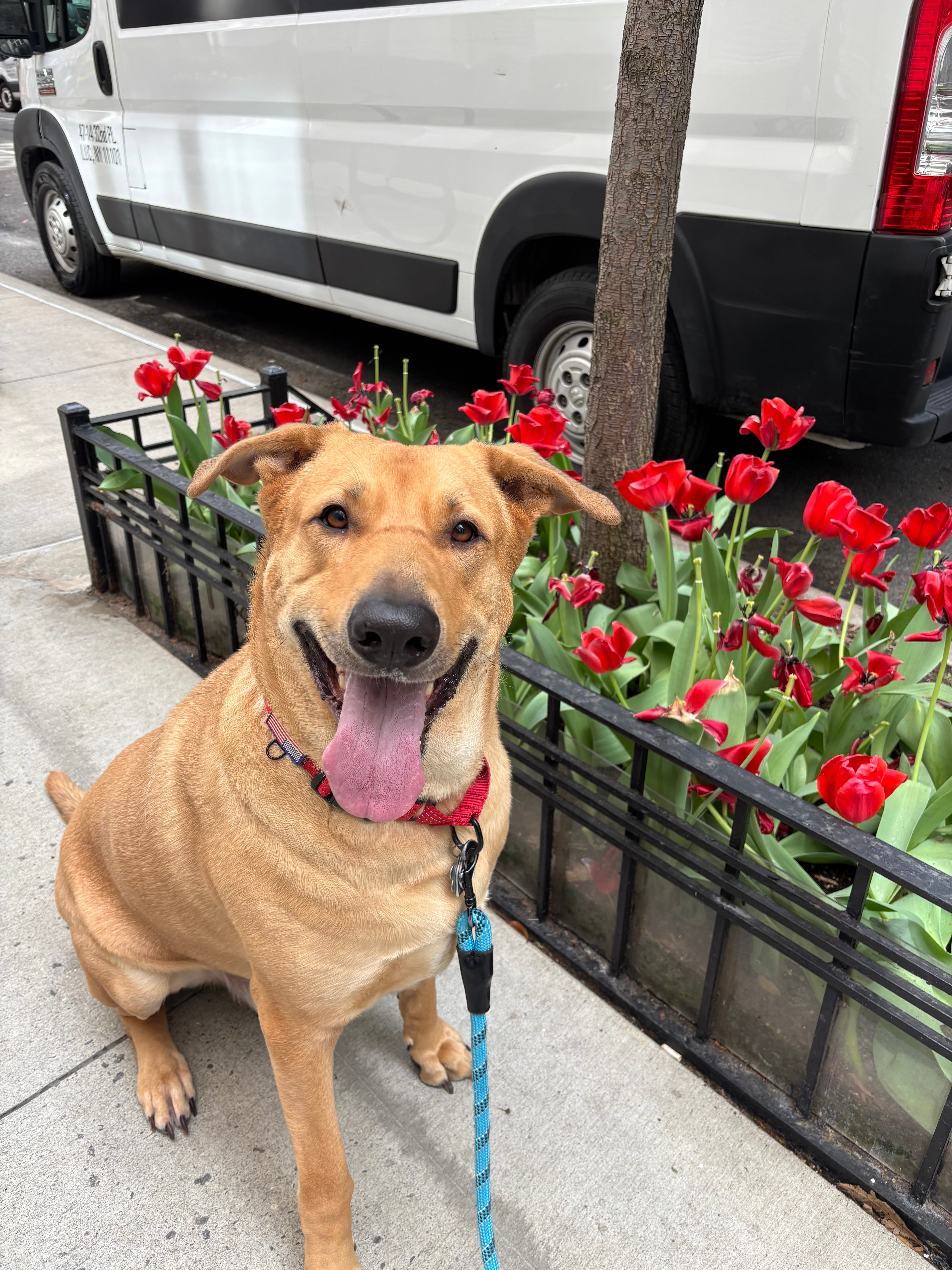
Jet. The third-best dog in the world in the history of dogs.
My grandfather’s dog. The black Lab he loved, a lifetime ago.
He was not easy — a big, anxious puppy who would take months to settle. And within days, we had to move. I had been planning it for a while; still, it felt strange to leave the apartment where Jake had taken his last breaths. We moved back to Manhattan — my old neighborhood. I was his foster, not his owner, and some days that distinction felt real. There were moments I almost didn’t keep him. He was terrified of men, and maybe city life was too much for him.
But I kept him. And boy, was I wrong. He loves city life, and now men, with few exceptions.
He is not Jake. He will never be Jake, and I stopped needing him to be. Every dog I have loved has been so unlike the others that each one asked me to become someone I wasn’t before. This one — this difficult, particular puppy, more demanding of patience than I sometimes think I have — is the one I can write now. He challenges me. He teaches me. He is here.
When I fix his food, I do it the same way every time. Dry kibble, and a homemade stew I make now, because we know better than we did then. Water poured over and left to seep in. Then the stirring — slow circles, working it into a gravy, the proper way to feed a dog.
I sing it to myself, quietly.
Stir, stir, stir.
And somewhere in the stirring, I take a deep breath — I always do — and I remember my grandfather Al. My shoulders come down. They come down the way they used to at a door on the southwest side of Chicago, when I walked in and was known.
My grandfather’s words. In my kitchen. For a dog I never named.
I asked a dead man to be at the door on the other side.
He answered.
Stir, stir, stir.
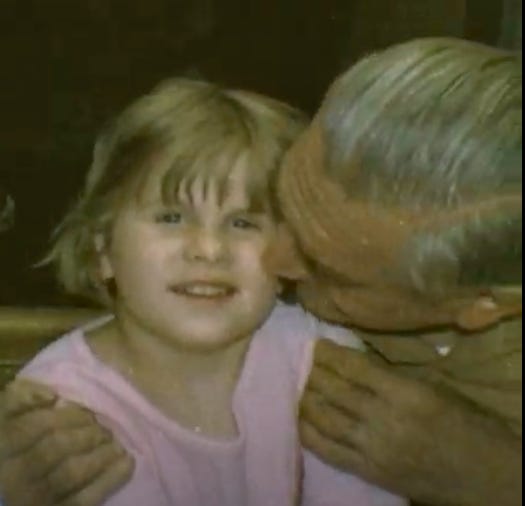
Grandpa Al and me
If this moved you, consider becoming a paid subscriber. Here's my promise, and it's specific: for every fifteen paid subscribers I gain, I become a paid subscriber to another Substack writer. Your support doesn't only keep me writing — it puts money back into a living ecosystem of people thinking out loud, and keeps the encouragement circulating to the next writer, and the next. Free or paid, I'm genuinely glad you're here. But if you can, help me keep that circle turning.
or
Jake
Jet
My sons believe in reincarnation at the moment (religions fluctuate when you're young). I know Jet probably isn't a reincarnation of your grandfather's dog, but it made me think about those conversations, and what a privilege it is to look after animals and children. Your grandfather knew it, I wish your parents did.
And I'm in awe of how strong you've shown you are. To come out of all that with optimism and grace, and to keep putting it out into the world even on days you probably feel awful. Bloody hell Meg, am I glad I met you! If I could I would bake you and Jet a great big, sugar free, cake covered in strawberry butterflies.
Serendipity in action,
and I love reading these stranger than fiction stories.
What a blessing it is to have had the privilege of being a caretaker for the most loving beings on earth .
who take care of us more than we them more often than not.
I love that you had amazing grandparents as much as I feel saddened about you at home life.
Meg, you are a kind, brilliant, amazing person, and it’s as much of a blessing to interact on here with someone who can care for man’s best friend as you do.
💛