
The Thirteenth Light
Behind the Poem: 'Once in a Blue Moon'

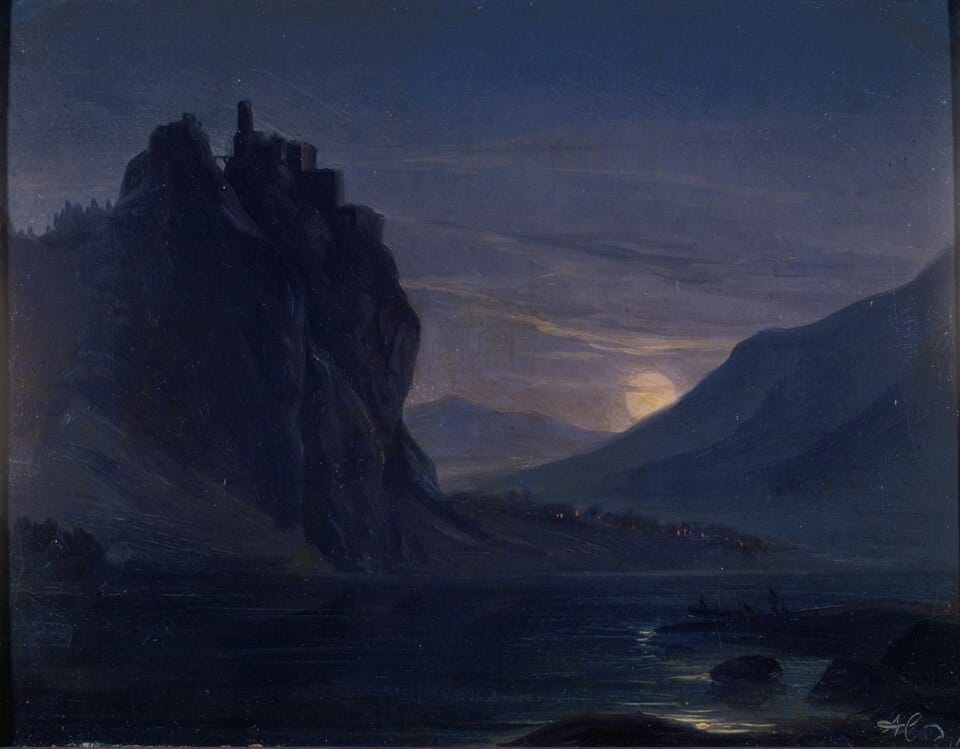
This poem is a wish. I need to say that before anything else, because the whole logic of a blue moon — in folklore, in spiritual tradition, in the oldest layers of its meaning — is that it is the time to wish. The rare moment. The second chance. The gate opens when it is not supposed to open and will not stay open long.
When a blue moon rises, you make a wish. So: this poem is mine.
The Tradition of the Blue Moon Wish
Across pagan and Wiccan traditions, the blue moon is understood as a time of amplified lunar energy — not just a full moon, but the full moon doubled, intensified, charged with the power of the extra and the rare. It is the time for the magic you don’t work every month. Major decisions. Deep healing. Brave intentions. The things you have been holding back because the moment didn’t feel sufficient.
The blue moon gives you a second chance at what the first full moon of the month set in motion. It is understood — in these traditions, and in the folk beliefs that predate them — as a turning point. The thing that does not come around often. The moment when the gate between what you want and what is possible opens a little wider.
In some cultures, the blue moon was considered fortunate — something to celebrate, to act under, to plant long-term intentions into. In others, it was the trickster moon: the doppelganger, the extra, the one that shouldn’t be here and therefore carries unpredictable energy. Either way, it was charged. Either way, you paid attention to it.
And in the popular tradition — in the same American culture that gave us the song, the phrase, the Trivial Pursuit answer — wishing on a blue moon is understood as wishing for the thing you thought you couldn’t have. The luck was so rare it would take a blue moon to produce it. The second chance you stopped believing in. That is what I stood under on May 31st. And the wish I made was this poem.
The Phrase, and What It Used to Mean
The phrase “once in a blue moon” first appeared in print in 1821, in Pierce Egan’s Real Life in London. But it was already old language then, already an idiom. Before that, in the 1500s, “the moon is blue” meant impossible — the English Renaissance equivalent of “when pigs fly.” An absurdity. A joke about things that will never happen.
Then Krakatoa erupted.
In August 1883, the Indonesian volcano exploded with a force equivalent to 10,000 Hiroshima bombs — one of the most catastrophic volcanic events in recorded history. The blast hurled ash and fine particles into the upper atmosphere: particles precisely the right size (about 1 micron wide) to trigger a phenomenon called Mie scattering, which filters long red wavelengths while letting short blue ones pass through. For nearly two years, people around the globe looked up at a moon that was genuinely, visibly, scientifically blue.
Impossible became rare. The language shifted with the ash in the air.
The modern “second full moon in a calendar month” definition arrived accidentally in 1946, when amateur astronomer James Hugh Pruett published an article in Sky & Telescope that misread the Maine Farmers’ Almanac’s more complex rule, which defined a blue moon as the third full moon in a season containing four. Pruett’s simpler version spread. Trivial Pursuit printed it in the 1980s. By the time most living people learned what a blue moon was, they learned the mistake — the version that stuck because it was easy to remember.
Which is its own story about how official knowledge gets made.
May 31, 2026. The second full moon of May. A blue moon rose over this city — and over a world that had been given, again, more than the calendar planned for.
What the Moon Has Always Meant
Before I talk about what the blue moon found when it rose, I need to talk about what the moon has always been.
Across nearly every human culture that has ever existed, the moon was not a decoration. It was infrastructure. Before clocks, before calendars, before any official system of time, the moon was how you counted. How you planted. How you knew when to move, when to stay, when the floods would come, when the fish would run.
In ancient Mesopotamia — the oldest urban civilization we know of — the moon god was called Nanna in Sumerian, Sin in Akkadian. He was not a minor deity. He was among the most powerful: god of the moon, of wisdom, and of timekeeping. Ancient Mesopotamians linked lunar cycles explicitly to the fertility of the body, of the soil, of the floodplains that made agriculture possible. The moon was the clock by which civilization organized itself.
In ancient Egypt, Khonsu was the lunar god, governing the moon, time, and fertility simultaneously, because in that tradition, these were not separate things. The moon tracked time and made things grow, and those two facts lived in the same body.
In ancient Greece, the moon held three goddesses. Selene drove the moon chariot across the sky. Artemis governed the hunt, the wilderness, and the protection of women. Hecate ruled the dark moon — the crossroads, magic, the threshold between worlds. Three aspects of one power, cycling through phases.
In China, Chang’e — the moon goddess — consumed the elixir of immortality and ascended to live on the moon forever, in exile and in solitude, her husband below, the distance between them unbridgeable. She became a symbol of longing and of things desired that cannot be reached. Of the wish that finds no gate.
In the Wiccan and pagan traditions that carried this older knowledge into the modern world, the full moon is always a time of power — of heightened intention, of clarity, of access to what is usually just out of reach. And the blue moon, the extra full moon, is the full moon amplified. The rare charge. The moment when what has been gathering finally finds its release.
Every culture that has ever looked up at the moon has understood this: it is not simply light. It is time. It is a body. It is the cycle by which living things know when they are. The human body, like the moon’s cycle, operates on approximately 28 to 29 days. Ancient Mesopotamians documented this. The connection between the lunar cycle and menstruation — the tidal pull of the body moving with the sky — has been known since the earliest human writing.
The Scale of What We Are Wasting
May gave us two moons. Two harvests. The world doubled its offering — and we threw most of it away.
I want to put numbers on this, because the poem names the sealed store and the banked grain, and I don’t want those lines to feel like a metaphor. They are not metaphors.
The United States discards approximately 120 billion pounds of food every year — nearly 40 percent of the entire American food supply. Per person, that is 325 pounds of food wasted annually. Food is the single largest component filling US landfills, making up 22 percent of all municipal solid waste.
Food loss and waste generate 8 to 10 percent of all global greenhouse gas emissions. The global economy loses $1 trillion annually to food that was grown, processed, transported, and thrown away.
Meanwhile, 733 million people — approximately 8.2 percent of the global population — experienced hunger in 2024. In Africa alone, more than 307 million people faced hunger, more than 20 percent of the continent’s population. An estimated 2.8 billion people — 35 percent of the world — cannot afford a healthy diet. Projections suggest that by 2030, 512 million people could be chronically undernourished.
The UN Food and Agriculture Organization has stated clearly, in multiple reports, that current global food production already exceeds what is required to feed every person alive. This is not a production problem. It is not a capacity problem. It is not a problem of the earth offering too little.
It is a problem of the sealed store. It is a problem of the banked grain.
It is a problem of who controls what the world has already grown — and what they decide to do with it.
Two Kinds of Time — My Framework
The ancient Greeks had two words for time. Chronos — clock time, calendar time, the numbered month, the fiscal year, the twelve-month grid with its official names and official harvests. Administered time. The time of the sealed store.
And Kairos — the charged moment. The ripe moment. The threshold is when something waiting finally arrives. Time as the body experiences it, not time as the empire administers it.
A blue moon is a Kairos event wearing a Chronos costume. By the calendar, it is overflow — a remainder, the math that doesn’t divide evenly. By the body, by the tide, by the rhythm of the earth, it is simply the moon, returning, as it always has. What we call extra is only extra relative to the grid we imposed over the moon’s actual movement.
The sealed store is a Chronos operation. The grain is banked inside the administered year, inside the fiscal structure, inside the system that accounts for it as an asset rather than food. The blue moon breaks through that. The thirteenth light rides in from outside the count. And the wish — the poem, the command in the final couplet — is a Kairos demand: right now, in this rare moment, while the gate is open, go.
From here, this is for paid subscribers.
What follows: the full history of the sonnet form, and the complete stanza-by-stanza breakdown — every line, every word choice, every symbolic layer. The thinking behind every decision this poem made.
I run a 15:1 campaign: for every fifteen paid subscribers, I become a paid subscriber to another writer’s work. This is not a platform. It is an ecosystem. You support it. I pass it forward.
