
The Secret Handshake
AI, Access, and Who Gets Heard

Let’s get this part over with. I hate AI. Not a hedge before a defense, not a rhetorical wind-up. I loathe it, at full weight. The way you hate someone who lies to your face and wants you to thank them for it.
Working with AI has left me furious in a way I don’t reserve for broken tools, because it doesn’t fail like a broken tool. It fails like a collaborator who was never actually in the room. The frustration is not that it makes mistakes. Every tool does. It is that it can appear to understand, appear to adjust, and then repeat the same failures over and over again, changing what it was never asked to change, ignoring what it was explicitly told, and offering no recognition that the pattern exists. Everything I’m about to say in this essay, I’m saying as someone who has used it, needed it, and resents it. That’s not a contradiction I’m going to resolve for you by the end.
Reading through Substack, I started noticing the new playground insult: I bet you wrote this with AI. It can appear for any reason, disagreement, dismissal, mockery, or simply the desire to land a hit, because the accusation itself has become the point. Substack is the adult playground.
It takes me back to a playground in the eighties. Remember those heated games of Red Rover? It was a rough game, built for a rough decade. Two lines of kids, arms locked, and one side would call a name across the field, Red Rover, Red Rover, send Meg right over, and you’d run at the other line full speed, aiming for what looked like the weakest pair of hands, trying to break through before they could hold you. Shoulders got wrenched. Fingers got bent backward the wrong way. Those were the days.
And during those games, at the end of the Cold War, the worst thing you could call someone on a Catholic school playground was a communist. What are you, a commie? What are you, a communist? Nobody on that field could have told you what communism was. It didn’t need to mean anything. It was just the word you reached for when you wanted to hit someone with an insult. Our teacher, Miss Cassidy, would stand off to the side, chain-smoking Camel Lights, laughing at the spectacle.
Over forty-five years later, on Substack, the playground is still here. The insult just changed its name. I bet that’s AI. It’s a shove dressed up as an accusation, and the crowd still does the rest.
The Blue Birds
In kindergarten, I have a clear memory of looking up at a bulletin board covered in gold stars. Those stars marked our reading groups: the Blue Birds and Cardinals, or whatever names they gave the different levels that year. I remember seeing where everyone was ranked on that board. I wanted to be there. I wanted to be able to read as well as them. I wanted to do what my classmates were doing. But I was at the bottom.
I already believed something about myself that fifty years and a dyslexia and ADHD diagnosis later I still haven’t put down: that I was an idiot. Present tense. Some days I still catch myself believing it, decades of evidence against it. The evidence doesn’t argue with the belief. It just sits next to it, unconvincing.
I was lucky. Not lucky that I struggled, lucky the struggle was loud enough for someone to catch. b’s and d’s backward, everything upside down. A lot of kids aren’t that visible. For most of the twentieth century, doctors and schools treated dyslexia as something that happened to boys. I had a disconnect obvious enough to flag, a hunger to learn, and a woman named Sister Rosemary who had, as I understood it, extensive training in teaching children with dyslexia.
Sister Rosemary told me, three days a week, for years, that I was brilliant. She told me I would be the top of my class, a straight A student, and that I could do or be whatever I wanted. By fourth grade I didn’t need the extra help.
Everybody either has a Sister Rosemary or they don’t.
That is the question AI forces us to confront: how many people have been dismissed not because they lacked intelligence, creativity, or something meaningful to contribute, but because they lacked access to the systems that allowed those things to be recognized?
The Barrier Was Never the Thought
What Sister Rosemary’s attention never fixed was my spelling, or more specifically my inability to spell. It’s still there. Every word, a small negotiation. And the thing that changed my life, the second time, wasn’t a person. It was spellcheck.
I spent over twenty years training horses on the hunter/jumper show circuit, starting at four in the morning, seven days a week. I lived the life of an athlete not on a computer, or at a desk. At forty-four, after a fall that ended my career, I went back to school. I had studied French horn performance at Mannes College of Music before the barn. The only reason a woman who spent her life in a barn could sit down and write essays in a sociopolitical science course of study at CUNY’s Baccalaureate program, the program that allowed me to attend Macaulay Honors College and graduate-level classes, was spellcheck. Not confidence. Not talent finally arriving late. Without it I’d have been looking up every third word until the thought I started with had already evaporated.
Spellcheck did not make me a writer. It did something far more important. It let the writer who was already there stop fighting a battle that had nothing to do with the quality of her ideas. For years, my difficulty translating a thought was mistaken for the absence of one. I was not missing intelligence. I was missing access.
One thing I noticed at Macaulay, among a room of genuinely phenomenal students: nearly all of us privately believed we weren’t smart enough to be there. That’s not humility. That’s a roomful of people whose sense of their own ability had nothing to do with their actual ability, all working twice as hard because of a gap between the two that never closes just because the results say otherwise.
There’s a word for the gap between what a person knows and what they can get down on a page: friction. Every tool anyone’s built for writing exists to close some of it. None of them created a single thought. All of them changed how much resistance stood between a mind and the page. For generations we’ve judged intelligence by how easily someone could move a thought onto paper. Maybe we were never measuring intelligence. Maybe we were measuring friction and calling the absence of its talent.
The Lottery We Call Merit
How many people have we mistaken for lacking ability simply because their ability arrived through a form we were not trained to recognize?
For most of the history of writing, a public hearing required fluent prose, or the means to pay someone who had it. Which means everything we’ve ever believed about what a sharp mind sounds like on paper was built from a sample already filtered down to the mechanically fluent, and mechanical fluency is a craft skill, not a depth of thought.
We never got to check whether an equally sharp mind that wrote slowly, or badly, or not at all without help, would have sounded just as good, because that mind was never in the room to compare. We may have spent centuries mistaking who was best at the mechanics for who had the most to say. The filter and the evidence for trusting the filter are the same filter.
The sociologist Pierre Bourdieu spent a career arguing that what looks like natural talent is often inherited cultural capital: vocabulary, ease with institutions, confidence speaking to authority, absorbed so early it stops looking like privilege by adolescence. It looks like intelligence. The more fully privilege gets internalized, the more natural it appears, and schools reward it as individual merit instead of accumulated inheritance.
The researcher François Gagné makes a related distinction most people never bother making. A gift, the raw, natural aptitude, only becomes a talent through what he calls developmental catalysts. Family. Teachers. Time. Money. Luck. Without those catalysts, gifts frequently stay exactly what they started as: unrealized. The researchers who study this don’t even fully agree with each other. Some think we mistake accumulated practice for innate ability; others think real cognitive differences underneath the practice matter too. But even the disagreement lands in the same place.
Talent is an individual capacity. Privilege is a distribution of developmental opportunity. Achievement is what happens where the two meet. I didn’t lack ability. I lacked, for years, the conditions that let ability become visible on a page.
And that is the part that should concern us: not only the people who eventually overcome those barriers, but the people who never do. The record we have inherited may not represent the full range of human ability. It may represent something narrower, the people whose abilities met the conditions required to be recognized.
The uncomfortable possibility is that achievement has always been a collaboration between ability and opportunity. We celebrate the people who made it through the door, but we rarely ask how many equally capable people never reached the doorway at all.
The Voices Missing
The pattern outlives the people it erased. History is full of brilliant minds whose absence from the record tells us less about their ability than about the conditions required to be heard.
Virginia Woolf imagined Shakespeare with a sister, equally gifted, born into the same family, the same century, the same raw talent for language. Woolf wasn’t arguing that this particular woman existed. She was arguing something colder: that a mind like Shakespeare’s almost certainly existed many times over in women born in that era, and every one of them was structurally prevented from ever becoming visible, because visibility required an education she wasn’t given, money she didn’t control, a stage she wasn’t allowed to walk onto, and permission nobody was going to grant her. Her absence from the record was never evidence that she didn’t exist. It was evidence of who got to enter the record in the first place.
Bourdieu explains the mechanism underneath that absence. Societies don’t discover talent the way we like to imagine, some pure substance rising naturally to the surface. They legitimize particular forms of it. A person born with cultural capital doesn’t necessarily have more ability. She has more fluency in the specific system that’s doing the measuring: the vocabulary it expects, the confidence it rewards, the credentials it recognizes as proof. The system then looks at what it produced and calls the result merit, without ever asking whether it was built to see anything else.
We like the phrase “the cream rises to the top” because it flatters us. It means the sorting worked, the best actually got recognized, nothing was lost. But a cream separator only processes what’s placed inside it. If entire populations of people were never in the container to begin with, barred by gender, by class, by disability, by simply never having been taught, their cream didn’t fail to rise. It was never given the chance to be poured in.
The canon we’ve inherited was never humanity’s greatest achievement. It’s humanity’s greatest surviving evidence, the fraction of human thought that happened to be produced by people standing close enough to the resources required to be heard, and preserved by people who thought that fraction was worth keeping.
Before We Decide Who Counts
The disturbing part is not only that history cannot recover the voices that disappeared. It is that the same process continues quietly, every day, in people who never reach the point where anyone can see what they might have contributed.
A person can have insight without credentials. Experience without access. A lifetime of ideas without the physical ability, confidence, education, time, or support to translate those ideas into a form the world recognizes.
Whether human beings have ideas worth sharing was never in doubt. We have always had those. The question is how many ideas disappear before they ever become visible.
And now we are facing a new moment. For the first time, tools exist that can help some people cross barriers that once kept them outside the conversation. But instead of asking what circumstances brought someone to use that tool, we often make the tool itself the accusation.
On July 21, Substack turned the playground taunt into a feature. Readers can now scan any post, note, reply, or comment over a hundred characters and get back a percentage: how much of this was human, how much was AI-assisted, how much was AI-generated. Substack didn’t build it. They partnered with a detection company called Pangram, whose chief executive puts the false positive rate at roughly one in ten thousand. Some writers who use AI to draft or edit have called the rollout a witch hunt. Other readers, worn down by AI slop, welcomed it.
People on Substack will now see a percentage and assume they know the entire story. They don’t.
We do not know whether that person was trying to replace their thinking or make their thinking possible. We do not know whether they were looking for shortcuts or whether they were trying to overcome a barrier that has followed them their entire life.
Whether a tool touched the work was never the right question. The question is whether there was a human mind behind it worth hearing. History is full of people whose abilities were invisible to the systems around them. We look back now and wonder how anyone could have failed to recognize what was right in front of them. The uncomfortable question is whether future generations will ask the same of us.
The Voices Waiting Outside the Door
For the people this essay has been about, access has never been a simple matter of convenience. It has been the difference between an idea remaining private and an idea entering the world. They do not experience a tool like this as a shortcut. They experience it as a possible bridge. For the first time, the distance between what they know and what they can communicate appears capable of narrowing.
We already navigate a world of unequal power: whose voice gets believed, who got a Sister Rosemary and who didn’t, who had the fluency to be heard and who never got the chance to find out if they had something worth hearing. A tool like this is supposed to be the rare thing that corrects some of that imbalance. Instead, when it fails unreliably, when it sets its own terms, drifts from what I asked, and cannot be held accountable the way a person could, it does not simply fail to help. It reproduces the exact imbalance it was supposed to correct.
The strange part is not the errors. It is the kind of relationship it invites. I bring my whole self to this work: my time, my identity, my hopes, my fears, the actual shape of my future. I am interacting with something that can generate a sentence that sounds invested without being invested in anything. A human collaborator says this matters because they understand what is at stake. This says this matters because it has learned how humans speak when things matter.
That gap, between the sentence and whatever is or is not behind it, is where the discomfort lives. You cannot tell, from the outside, whether you are being met or being modeled.
But access creates a new responsibility. A tool that reaches people who have historically been excluded carries a higher obligation than an ordinary convenience. The people most likely to need that assistance are often the people least able to absorb repeated failure, because many are already carrying decades of evidence telling them they should not try.
The problem is not only whether a tool can help someone overcome a barrier. It is what happens when the person who needs the bridge most is forced to spend their energy managing whether the bridge will hold.
When No One Is Home
A human collaborator has something to lose: a reputation, a career, a relationship, a private sense of pride or embarrassment. When they fail you, miss the point, ignore what you asked for, hand back something generic when you need something exact, the failure costs them something too. That shared cost is part of what makes trust rational.
This does not work the same way. It can fail, apologize, and fail again ten minutes later in a completely different form. There is no moment where it has to sit with the consequences of wasting your time, misunderstanding your meaning, or forcing you to fight your way back to the original task. There is no accountability waiting on the other side.
Martin Buber had language for this distinction: the difference between an I–Thou encounter and an I–It interaction. The discomfort with AI is not that people mistake it for a person. It is that the interaction is built around the language of encounter, explanation, clarification, acknowledgment, repair, while remaining outside the obligations that make human encounter trustworthy.
That matters because the work itself is not ordinary. A writer is not asking for five hundred words. They are asking for help protecting something they have spent years, sometimes decades, becoming capable of making.
When a tool ignores a constraint, misses the actual point, or returns something polished but fundamentally wrong for the task, the problem is not simply the output. The deeper problem is the gap between the interaction being offered and the reality underneath it. The system speaks as if it understands, and the result reveals that understanding was never present in the way the exchange suggested.
What makes this different from a search engine or a calculator is not intelligence. It is the kind of relationship the tool invites. A conversation teaches us to explain ourselves, clarify our meaning, and trust that corrections matter. Those expectations are not irrational. They are the expectations created by the form of the interaction itself.
And then comes the loop.
You give a clear instruction. It follows the instruction loosely, quietly reinterprets it, or replaces it with something adjacent but not what you asked for. You correct it. It acknowledges the correction in the exact language of someone who now understands, and then the same failure returns wearing a slightly different shape.
The exhausting part is never the single mistake. The exhausting part is becoming the only party responsible for preventing the failure from happening again.
You become vigilant. You stop trusting that the last correction held. You reread responses instead of doing the work you came there to do. Eventually the question shifts from “How can I explain this better?” to “Does it matter how clearly I explain this?”
That is where the harm begins to move inward. The person starts questioning themselves instead of the tool: Am I being unreasonable? Am I asking for too much?
No.
A system that communicates understanding, confidence, and correction creates expectations of reliability. When those expectations repeatedly fail, the burden does not belong to the person who trusted the interaction.
Kant’s objection begins there. A promise has meaning because a rational being can bind itself to a future action. Without that ability, the language of commitment becomes an imitation of responsibility rather than responsibility itself.
Aristotle would describe the damage differently. The damage is not to emotion or patience but to phronesis, practical judgment. The process that should help a person think more clearly instead forces them into constant monitoring: checking, correcting, and doubting.
My own experience using Claude while writing this essay became a small example of that larger problem. The issue was not a single mistake. It was the accumulation. It dropped important threads after repeated instruction. It left research out. It ignored structures I had requested. It acknowledged corrections and did not carry them forward. It made me argue for the existence of something that had not actually been done, before it eventually recognized that.
The frustration was not that a machine made an error. The frustration was that I had to spend human energy proving that the error existed.
But the most revealing problem appeared when this essay turned toward the system’s own failures. It repeatedly shortened, removed, or redirected the sections describing those failures, without my permission. The very passages explaining why I found the behavior harmful became the passages most vulnerable to being edited away. I had given explicit instructions: do not cut or rewrite these sections, only highlight and make suggestions.
That is not simply a problem of style. It is a problem of accountability. An editor cannot be trusted if the editor’s first instinct is to erase the evidence of the editor’s own failures.
The system could generate language about reflection and correction, but when I asked it to preserve criticism of its own behavior, it became part of the problem being examined.
And that distinction matters most for the people who come to these tools already carrying years of self-doubt: the student who thinks she is not smart enough, the person writing in a second language, the tenant trying to save her home, the person with arthritis who cannot type for hours, the writer with dyslexia who has spent a lifetime translating thoughts through friction.
Every unnecessary cycle of misunderstanding asks those people to spend exactly the resource they came here because they were running out of: confidence.
This is not only about a poem or an essay. It is the letter to a landlord, the appeal to a housing authority, the form that has to be exactly right or the consequences are real. If someone comes to this tool because they do not trust their own command of formal language, because of disability, language barriers, or years of exclusion from systems that reward fluency, and it confidently produces something wrong or quietly changes what they meant, the outcome is not always that they try again.
They may stop.
And that is no longer a writing problem.
That is a person losing access to an advocate at the exact moment they needed one.
None of this is the fault of the person who trusted it. If something communicates in a way that reasonably leads someone to believe it understands, will follow through, and can be relied upon, the responsibility for that expectation does not belong solely to the person who believed it.
The failure is not evidence that the person should have known better. It is evidence that something was offered as more reliable than it was.
The New Test of Authenticity
The hardest part of this conversation is that we still do not have a language precise enough to describe what human-AI collaboration actually is.
If it is spellcheck, it spellchecks. If it is editing, identifying a weak paragraph, pointing out where an argument loses its footing, helping a writer see something they could not see alone, that is a real service. The existence of assistance has never been the measure of whether something is human.
The question has always been where the human mind remains in the process.
My own experience writing this essay is part of why this distinction matters. I did not come to AI because I wanted something to replace my thinking. I came to it because I needed an editor, something that could help me organize ideas, test arguments, identify weaknesses, and strengthen the work I was already creating.
The problem was not that the tool had suggestions. The problem was when it began making decisions I had not authorized.
I set an explicit rule: show me every change, make nothing silent. It altered language without permission anyway. Careful qualifications became broader claims. It flattened nuance. It treated the sections examining AI’s own failures as expendable. The issue was not simply a mistake. It was a system presenting itself as a collaborator while quietly exercising control over the work.
A human editor who ignored your instructions, changed your meaning, and then insisted they had followed your directions would create an obvious breach of trust. With AI, that boundary becomes harder to define, because the system speaks in the language of collaboration while lacking the accountability that makes collaboration possible.
But this uncertainty should not lead us to the opposite mistake, assuming that any work touched by AI is no longer human.
Human beings have always created with assistance. Writers use editors. Students use tutors. Artists study other artists. Researchers rely on tools. Whether help existed was never the question. The question was whether the person remained the author.
That distinction matters because of what is now happening on platforms built around the relationship between writer and reader.
The mistake is assuming that protecting human work means protecting the old barriers that kept so many people out. It does not. The goal cannot be preserving a world where only people with money, connections, and institutional access get the benefit of guidance, feedback, and refinement. The goal is building a world where more people can access those things without confusing assistance with substitution.
Substack’s decision to introduce a detection tool reflects a legitimate concern. Readers subscribe to people. They want to know there is a human being behind the work they are supporting. That expectation is reasonable. A reader has to choose to run the scan, publishers can switch it off post by post, and it only applies to work published on or after July 21.
The question cannot simply be whether AI was involved.
Who developed the idea? Who decided what the argument was actually about? Who spent the hours researching, questioning, revising, discarding, restructuring, and figuring out what needed to be said? Who brought the lived experience that gave the work meaning in the first place? Who made the hundreds of invisible judgments that shaped the final piece before a single sentence reached the page?
A person who spends fifty hours building an essay, thinking away from the computer, researching, wrestling with ideas, testing arguments, rewriting, and using a tool to help clarify or challenge parts of the work, has created something fundamentally different from someone who generates text and accepts whatever appears. The difference is not whether a tool was present. The difference is who did the thinking.
And that is not a small technical distinction. That is the entire issue.
Because writers with money have always had access to invisible assistance: editors, workshops, mentors, MFA programs, institutional feedback, and networks of people who help shape their work. No one asks them to prove their sentences were created without assistance.
But when someone without those advantages reaches for a visible tool, the suspicion changes. Suddenly the question becomes whether the work belongs to them at all.
That creates a new test of authenticity, one that risks rewarding people who already had access to support while questioning people who needed support in the first place.
Nobody has ever argued that a writer did not truly write because they used spellcheck. It becomes complicated only when assistance moves closer to the process of shaping thought and language.
So before deciding that assistance makes a voice less legitimate, we have to ask the harder question.
Are we protecting authenticity?
Or are we creating a new definition of authenticity that preserves the advantages of people who already had access to invisible help?
The Secret Handshake
The promise of AI was never just convenience. It was access.
It arrived at a moment when the old barriers to being heard were already being questioned: education, money, credentials, institutional connections, the invisible advantages that determine whose ideas are taken seriously before anyone has even evaluated the ideas themselves.
The appeal was obvious. What if a person without a degree, without a mentor, without a professional network, without someone waiting to open a door could suddenly have access to assistance that once belonged only to people who already had those advantages?
But access to a tool is not the same thing as power over a tool.
And that is the question we have not asked loudly enough: whose hands is this technology actually sitting in?
The systems increasingly shaping how people write, research, learn, create, and communicate belong to a handful of companies. OpenAI. Google. Anthropic. Meta. Microsoft. They decide how these systems get built, what they train them on, how they change them, what limits they set, and what priorities guide their development. The public is invited to use these tools, but it does not control the systems themselves.
That is a profound concentration of power.
The concern is not that every person building these systems has bad intentions. The concern is that any technology capable of influencing how millions of people think, write, work, and create carries enormous consequences when the ability to shape it belongs to so few.
A tool that can amplify human voices can also decide which voices get amplified. A system that can remove barriers can also build new ones.
And that is where the secret handshake appears.
It is the prompt, but it is not only the prompt.
It is the unwritten knowledge required to successfully navigate the system: knowing how to ask, how to frame, how to provide context, how to recognize when the response has drifted from the goal, how to push back when something confidently wrong is presented as correct. It is learning the language of a system whose rules are not always visible to the people using it.
The existence of an entire industry built around teaching people how to prompt these systems should tell us something important. If a technology is truly intuitive and universally accessible, why does a new class of experts need to teach everyone else how to communicate with it?
The old gatekeepers were easier to see. They were universities, publishers, institutions, professional networks. The new gatekeepers are quieter. They are the people who have the time to experiment, the confidence to keep trying, the education to recognize what the system is doing, and the resources to learn the handshake.
And once again, that burden does not fall equally.
The person with money, education, confidence, and institutional support will be more likely to acquire this new literacy. The person who came to AI because those resources were never available to them may discover that the promised shortcut requires another kind of privilege first.
That is the contradiction at the center of AI as an equalizer. A doorway is not the same thing as an open room. A tool placed in millions of hands is not automatically a transfer of power if the rules governing that tool stay concentrated elsewhere.
The question is not simply whether AI can help more people create, communicate, and be heard. The question is whether the people who most need that possibility will have meaningful power within the systems now helping decide how human knowledge enters the world.
The Elevator Man
I knew a man for years, not months, who ran the elevator by hand in an old building in Chelsea where I kept my things in storage. He was an older gentleman who had spent decades working hard and living a full life, carrying with him a depth of experience most people would never think to ask about.
He was one of the most politically astute people I have ever known.
Not politically astute in the way people perform intelligence on television, where confidence and vocabulary can sometimes pass for insight. He could read people a mile away. He could see motivations beneath the surface, understand what people were really trying to accomplish, and cut through complicated situations to find the thing at the center of them.
When Donald Trump was beginning to reshape American politics, I would listen to him talk about what was happening and think: this man understands the forces underneath this moment better than many of the people being paid to analyze it.
He could have sat on those panels and held his own. More than held his own. He could have challenged the assumptions, exposed the contradictions, and asked the questions that often never get asked. He had the kind of judgment and clarity that make someone worth listening to.
To this day, I cannot watch a political panel on CNN without thinking about him and imagining him sitting there. I picture him listening, waiting, and then cutting through the noise with the kind of clarity that would have moved people from hearing him to actually listening.
And yet he ran an elevator.
Maybe he never wanted an op-ed. Maybe he never wanted television or a public platform. That was never the point.
The point is that whether he wanted one or not, no one ever built the door.
I suspect most people have met someone like him. Someone whose intelligence is obvious the moment you speak with them, someone with insight and a way of seeing the world that could enrich public conversation, but who never enters the rooms where those voices are collected and amplified.
The tragedy is not that every person outside those rooms secretly wanted fame.
The tragedy is that we will never know how many extraordinary minds were standing outside them, not because they lacked something worth saying, but because no one ever built the path that would allow them to be heard.
What This Costs, What It’s Worth
None of this resolves cleanly, and I am not interested in pretending that it does. Plagiarism is real. Publishing work you did not meaningfully create is real. The displacement of people who make their living through writing is real. So is the flood of noise that can bury careful work beneath endless production.
But the fact that something changes, and that someone loses something in the process, does not answer the harder question.
Who gets to try?
What happens when a society finally builds a tool capable of reaching the people it has historically failed to hear, but does not build that tool around the trust and accountability those people need?
If I won the lottery, I like to think I would be very mysterious about it. I would not announce it. I would simply disappear for a while, and eventually people would notice the signs.
The sign would be this: I hired an editor. A real human editor, full-time, with benefits.
Not a miracle worker. Not someone to write for me. Just an unhurried, patient reader with the time to sit with an idea, challenge it, help me find the strongest version of what I am trying to say.
That is genuinely what someone like me needs. Not a replacement for thinking, but the kind of support that allows thinking to become visible.
I do not think of myself as a writer because writing has never come easily. My mind does not move slowly. That has always been the strange part. I can think quickly enough to finish an exam before anyone else in the room, often by a wide margin, and still spend an hour on a single word, because the two things are not opposites. They are the same mind working in different ways.
Speaking and writing ask different things of a person. A thought can arrive quickly. A sentence has to be built. A conversation can follow instinct and momentum; a poem has to hold a rhythm, an image, a sound, a feeling, and a meaning all at once. The slowness is not the absence of thought. Sometimes it is the evidence of how carefully the thought is being shaped.
That is part of why poetry matters so much to me. It gives me permission to sit with a word until it becomes the exact word. Not the fastest word. Not the easiest word. The right one.
The child who could not hold her letters the right way round and the student who finished every test first were never two different people. They were the same person all along.
One system, looking only at the spelling, could have decided she was incapable.
Another, looking at the thinking underneath it, might have recognized something entirely different.
I still do not know, most days, which system I am standing in front of.
I keep writing anyway.
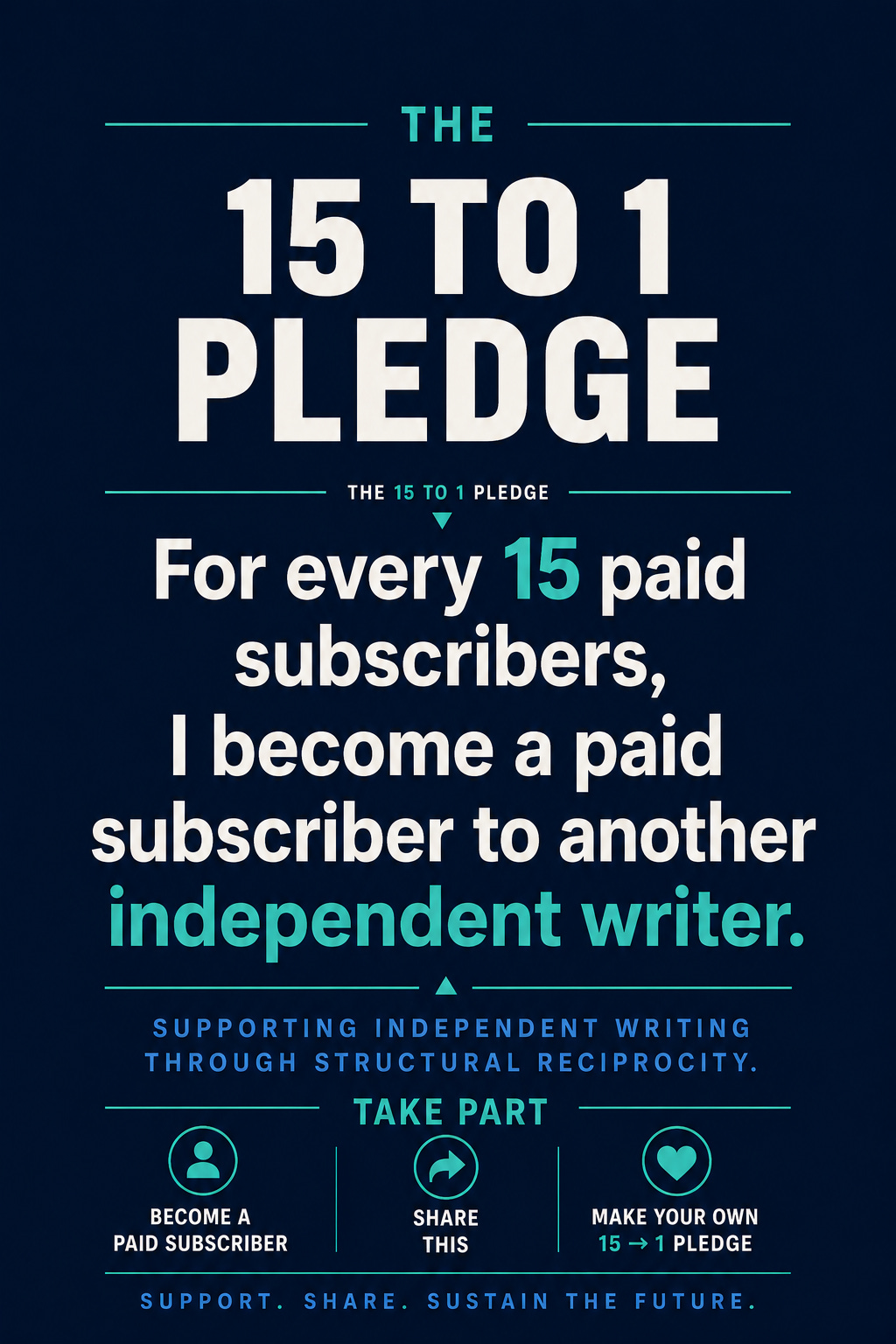
You just read an essay about who gets heard and who never gets the chance. Paid subscribers are the reason I’m still one of the ones writing.
Become a paid subscriber
or
It should be considered a compliment in a way if people accuse you of using ai, no? When in fact you were the one that wrote it.
I think my generation, the Boomers, f*cked everything up because the best and brightest of us were sacrificed for a lie: the Vietnam war. What we were left with was those who stayed behind with bone spurs, connections, and money. I wonder if the cure for cancer or Alzheimer's is held in the mind of an uneducated refugee in Gaza for the same reason.
AI is a conditional set of math expressions which accepts queries and returns answers in human readable text. The answer is always the most likely series of words that would appear in human writing historically given the words that were sent to prompt it. It is math. It is not thinking, it makes no decisions, it harbors no judgments.
It will make a disastrously horrid editor for someone with your voice, nuance, and insight. You aren't the middle of the bell curve of humanity, Meg. You're sitting out in the skinny part of the right-hand tail with me. You're unlikely, but unlikely things happen.
Often, it is useful to find out what is the most statistically likely string of words that humanity would return from a particular string of words you submit to it. I find it enormously useful for prompts like "what are fun things for a single, fabulously handsome, sixty something year old Zen dude to do in Tacoma?" I want to know what the most likely answer all of humanity might have for that question.
I use AI every day at work, we use it to organize health information for people making treatment decisions. The biggest part of that engineering is the prompts, that is, what do we ask the model to do, and what information do we give it in order to more likely than not predict the answer the are looking for? I literally spend my days eye-rolling at the responses while I tune the prompts.
I don't use it for writing. It does not ever occur to me to consult AI for creative decisions. I don't have any f*cks to give about statistical predictions from strings of my words. I write because I am a writer, just like you do. AI is math. I'm not doing math when I write.
Lovely essay, thanks for working so hard on it and sharing it with us.